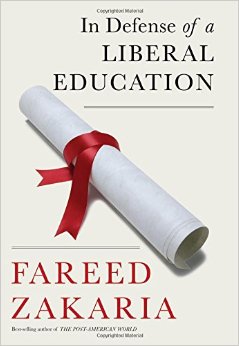
 I remember feeling sort of underwhelmed when I graduated from college. Though I was certainly exceptionally overwhelmed by the fact that I was being ripped from the safety bubble of college (not that I’ve gone very far even four years later), it seemed like such an inevitability that I would graduate from a four year institution that it didn’t strike me as anything to congratulate. It was always the plan to attend school through college graduation- I had just done exactly what I was supposed to do, per environmental expectations above all else. And given my qualitative-over-quantitative mind, a humanities-based liberal arts curriculum was the only way I was going to go.
(Digression: I acknowledge the point of privilege here. I know that I could not have fully appreciated the fortunate situation I was in throughout the college application process, surrounded by people who had pursued higher education and encouraged me to do the same. My time spent working in admissions has helped me to better understand the positive impact of my incredibly supportive network and has emphasized the need for increased focus on accessibility as well as encouragement.)
It’s an interesting week to have read this book, because we’re at both an end and a beginning in my office in terms of selling the liberal arts experience. We are wrapping up our yield season, hosting admitted students events throughout the past month at which we try to convince high quality students that they should choose our school over any other. I also spent part of this week on travel, selling the university to juniors who are at the beginning of their process (and this week in particular, those who attend high achieving private schools). April is always a bit of a weird month in admissions- having to go back and forth between the two mindsets with the same ultimate goal- and it was a bit strange to think about the idea that the product being sold was one that perhaps needs a defense in a larger context. This book made me think more critically about what I was talking about- we even promote our STEM programs within liberal education as an opportunity to explore many subjects.
The book itself is beyond fascinating- so much so that it’s hard to pick which pieces are the best and it would certainly be impossible to delve into the nuances of each argument in this (already super long) post. It’s a pretty quick read- just over 170 pages of actual analysis, with many pages of references. (I’m not blind to Zakaria’s past controversies; that said, his perspective is unique, well-written and seems to be thoroughly researched.)
I really appreciated Zakaria’s case for an emphasis on articulate communication- it’s a skill that many need and relatively few have. This is based partially in the concept that thinking intelligently is as important as writing or speaking well, but that the United States in particular has emphasized written research above spoken communication. It’s a fascinating point- Zakaria says that extracurricular activities (largely an American phenomenon, as I’ve read in the past) reinforce this need for articulate communication, yet there is a gap more evident in this country than in others.
There is also a strong case for liberal arts in conjunction with the sciences, as one struggles to exist without the other. Zakaria quotes Steve Jobs, who essentially stated that technology alone would not result in advancement; instead, it is art and science mixed together that create innovation. (My paraphrase.) There is a place for STEM and a place for humanities and their simultaneous existence is what helps to create a fruitful and productive society.
Overall, Zakaria is convincing- mainly convincing that liberal education will not set you back, but instead, enhance your understanding of the world around you. If you’re curious about the book, check out Fareed Zakaria’s interview on The Daily Show. They have a good chat about some of the context around the book with an overview of a few different aspects of the topic.
(Note: Zakaria probably did interviews on a bunch of shows, but like plenty of other 20-somethings who grew up watching him, I prefer interviews with Jon Stewart above just about anyone else.)
You’ll like this if: you have some investment in higher education, which means everyone should read it: if you’ve gotten a degree, your child has gotten a degree, you work in the field or you’re just concerned about the educational future of the United States/the world, this is a good one to pick up.
Happy reading!
 carlyreads